Showing posts with label C. Show all posts

12 January 2013

Zero Dark Thirty (Kathryn Bigelow, 2012, USA)

Before seeing Zero Dark Thirty, I was prepared to be scandalized and horrified, the same way I was when I saw The Hurt Locker. (Un)fortunately, the film is far too dull to be scandalous. The torture scenes are pretty tame, especially if you've seen documentaries like Taxi to the Dark Side. The film is basically a plodding procedural thing. I found it hard to care about anything because the entire thing was almost completely devoid of context. So I waited for something that felt like three hours for the big climactic scene to occur. This, again, was ruined by a dearth of context, though unlike the rest of the film it spared the audience the silly dialogue that seems to be Bigelow's hallmark. My only feeling after seeing the film was a desire to know who all the collateral damage types were, like the parents gunned down in front of their children, who may have just been neighbors. I found it really hard to tell what was happening during the big climax. I didn't care for the film, but it was too ponderous to get very revved up about. Also, I like Jessica Chastain. I've loved her in some roles. But I don't understand why her performance in this movie is seen as so incredible. The movie never asks any questions, like whether it was worth all the resources and lost lives to kill this man in the middle of the night. It felt worth it when I first heard the news, but watching this movie I started to wonder. Perhaps that was intentional, but again, Bigelow doesn't seem to like to get herself muddied up with ideas so it's hard to believe that's the case. C-

03 January 2013

Argo (Ben Affleck, 2012, USA)

Of the end of the year prestige type movies, this is one I had particularly high hopes for. Perhaps that's what set it up for disappointment. I was really struck by how unremarkable it was. It skimmed along on the surface from episode to episode, often feeling disingenuous or mendacious. The acting was okay, but most of the characters felt two dimensional. It also seemed to suffer a little bit from the "Will somebody please worry about the rich white people?" scenario. They never really established why we should care about these whiny privileged people. I also couldn't help but draw comparisons to the Chris Marker film The Embassy, which was inspired by the Chilean coup in 1973 that claimed the lives of Salvador Allende and countless others. Given that the events that inspired both movies are claimed to have been the result of American interference in the domestic politics of foreign countries, I have to say I found to feel too badly about the people in this story. There is one comment in the film where someone asks whether justice for the former shah would be the worst thing, and by extension one wonders if justice for the people who propped him up would be the worst thing as well. Mostly though, I feel like the movie is this glib story of Hollywood heroism that doesn't succeed in making you care too much about the people being rescued. I was also distracted by all the reports of historical inaccuracies in the story. It felt like a pointless manipulation and it left me as cold as Saving Private Ryan, in certain respects. C

10 November 2012

Holy Motors (Leos Carax, 2012, France)

You can't really deny that this film is a pretty pure example of masturbatory filmmaking. The filmmaker here has cobbled together all of these concepts of his in a way that seems very personal, and possibly somehow autobiographical. At the same time, the audience is constantly stroked, exactly like the audience in Woody Allen's Midnight in Paris for being hip to what he's doing here or there. It's also pretty easy to say it's like a David Lynch movie, but not as straightforward. For me, there were stretches of the film that I found tedious or insipid, but there were also segments that I found compelling or even beautiful.

Denis Lavant, who played the main character Merde in that annoying middle section of that omnibus film Tokyo! from 2008 or something, is back here playing the same character and about ten others. In the film, he is chauffeured around in a limosine, possibly with bodyguard protection, and taken to different "sessions" or appointments. The almost mystical chaufffeur is played by mesmerising Édith Scob, who is perhaps best known as the girl in Franju's Eyes Without a Face. Like many of the characters in the film, it's hard to know whether to think of them as benevolent or menacing. Perhaps, as in many dreams, the figures are meant maintain the suspense of that mystery. They make nine or so stops and at each stop, Lavant plays a different character: a gypsy beggarwoman, a green screen actor, that same stupid troll from that Tokyo!movie, an emotionally abusive father, a murderous gangbanger, etc.

Man is said to differ from other apes in his propensity to ask why. So watching all these episodes, which end in the chauffuer donning her Eyes Without a Face mask and leaving the cars to themselves, it's hard not to try to make connections. He's clearly working through something about the artist's role, probably about his own life as well, since the protagonist's name is the director's real middle name, and it ends with a photograph of his lost lover. Like any other story about artists, it's easy to see metaphysical themes in the piece. Maybe god is in all these people in all these acts. I don't know, maybe this guy is just self-absorbed and preoccupied with the grotesque. I can't tell if it's because I had lost patience by that point in the film, but I was really surprised by how absolutely bored I was during the entire Kylie Minogue scene. In constrast, I was pleasantly surprised by Eva Mendes in the film. She's in the session with the stupid troll, but for some reason the troll shtick just barely tips toward succeeding in this film while it pretty squarely hit with a thud in Tokyo! Weirdly, my biggest reaction to the film is that my new dream is to enter Paris by car some day. I think I've been to Paris three times, but all three times I entered by train. In fact, I don't think I've ever even taken a cab in Paris, but this film makes driving around Paris look incredibly beautiful, all the while eschewing a lot of the kitsch that that idea is probably conjuring in your mind. In fact, there are all kinds of gorgeous views of the city, particularly as they stand atop the historic Samaritaine department store, which is allegedly being converted into a hotel, according to the interwebs.

I imagine I will probably watch this movie again at some point in the future, but I can't think of many people I'd recommend it to. I'm honestly surprised by the critical reception it's received. It won the awards for best film, best director, and best actor at the Chicago International Film Festival. I wasn't surprised at all to find out at after seeing the film that the director's mother is a long time friend of the festival organizer. Maybe it was nepotism, my cynical side says. Of course, it's also true, as the French say, à chacun son goût. I don't know, I can see making love letters to the movies, but for me there needs to be more than that, and this film didn't really connect to me like it seems to connect to a lot of other people. Oh well.
C

It occurs to me while reading through these reviews that I really did love the film for about the first third and it gradually kind of wore on me. Like Roger Ebert apparently, it brought to my mind the Walt Whitman line, "I contain multititudes." I guess I'd also agree with Ebert that the film is exasperating and sometimes funny, though I didn't really sop it up as much as he did. It's amazing how all these reviews keep talking about how exciting and not boring this movie is, since I was more or less bored for much of the second half of the film. The sessions in the latter half become increasingly more dour and confounding, I thought. In reading these reviews though, it's surprising how many people, like myself, seem to have forgotten about one of the more enjoyable scenes in the film, the entr'acte, in which a band of hipster accordionistes rampages through an old church.
I've also discovered that the title refers to old film cameras and the movie, shot on digital for financial reasons, seems to be about the death of film in some ways, though the director says allegedly that this movie isn't about film at all. I feel as gypped as the next guy when it comes to seeing a movie in digital projection, but I don't know how thrilling a two hour lament on the subject is.
It's funny as I read through the reviews listed at mrqe.com, everyone seems to agree that this movie will elicit all these possible responses from the audience. It's a unique film, but it's not as unique as people say it is. It can be touching, it can funny, and it can be frustrating, but I really don't see why people react so strongly to it. There was one review somewhere that said that the film says most of what it has to say in the first few episodes. I'd agree with that. My own experience of the film is that it would have benefited from some trimming, since like I said before there were some significant dull patches in the second half of the film.

09 November 2012

Deadfall (Stefan Ruzowitzky, 2012, USA)

One of the many strange things about this movie is that it was directed by the director of the Oscar winning foreign language film The Counterfeiters. Eric Bana and Olivia Wilde star as siblings on the run after having robbed a tribal casino in what I took to be Michigan. Their flight toward Canada has been deranged by a freak car accident on a snowy country road. I'm not sure whether I should start with the strengths or the weaknesses here, because they probably balance each other out.

Their stories smash up against a few families in and around the community of Beaver Lake. All of the people involved seem to be struggling with the same sorts of family troubles that fuel the madness of our pair of siblings, particularly Eric Bana. Eric Bana's character seems to have some weird incestuous energy flowing toward his sister, but she ends up looking for redemption with a disgraced Olympic boxer fresh out of prison, played by Charlie Hunnan. The boxer's parents are a retired sherriff or something played by Kris Kristofferson and idealized homemaker Sissy Spacek. The boxer and the father naturally have issues. The new sherriff's daughter, a friend of the family, played by Kate Mara, also has issues with douchebag father.

Basically everyone in the whole movie has trouble with their fathers, probably because aside from Kristofferson's charcter, they're all total scumbags. The actors are all pretty good and they really tip the scales toward making this film worth watching. The only trouble is the film gets kind of weighed down in sorting out everybody's endless family dramas which keep playing out all over the place. It's also tricky becayse you're trying to follow along with Eric Bana, but he does a couple of things that are hard to forget about, which makes the ending a little flat. It's a mess, but it's probably worth renting from VOD if you're pining for something new on the VOD.
C

Mission: Impossible (Brian DePalma, 1996, USA)

It's strange that I'd never seen this film before, or maybe not, since I've rarely ever liked Tom Cruise (possible exceptions being largely films he starred in from 1999-2002, and possibly Collateral). On the face of it, it seemed relatively promising. Brian DePalma, Kristin Scott Thomas, Emmanuelle Béart, Vanessa Redgrave. Add to that that I saw John Woo's M:I-2 in a second run theater because its coincided with the time I was assigned to write a paper on John Woo and auteur theory during my brief stint as an intended film studies major. I haven't seen M:I-2 in a dozen years, but I can only hope it's nowhere near as dated and unsatisfying as this one. It's funny, I think I've been wanting to see this movie since about 2001 when my French teacher, in one of those oddly random foreign language class moments, showed us part of the sequence on the train, to demonstrate, apparently, that the TGV (train de grande vitesse) was in fact de grande vitesse.
I kind of feel like the most remarkable thing about this movie are the talents it squanders. It's amazing that Brian DePalma produced such a dull film. As tedious as any lesser James Bond movie, it seems to follow the same blueprint, which naturally includes offing the most interesting woman in the first fifteen minutes. Kristin Scott Thomas is riveting in her scenes, but so are Emmanuelle Béart and Vanessa Redgrave. Weirdly, Emilio Estevez is also quite effective in his small part. Jon Voigt and Tom Cruise on the other hand are beyond tedious. Not that it would have mattered if that plot had made sense at all. It's this weird combination of setpieces connected only by the most strained bit of logic. Ving Rames and Jean Reno are brought on halfway through the movie to steal some data from CIA headquarters in a dull, drawn out "action" sequence notable only as a potential missing link between the 70s and the 21st century. Ving Rames is completely wasted in a flat characterization, but Jean Reno is relatively effective given the limitations of the script.
blah blah blah
There was a nice moment at the end where Mazzy Starr is playing at a cafe.
C-

05 November 2012

Total Recall (Len Wiseman, 2012, US)

I think it's borderline hilarious the way people compare this to the original as though the original film were any good. For me, the Schwarzenegger film is hard to watch, since the only redeeming qualities I found in it were Sharon Stone's shoulder pads. It's silly and the special effects are embarrassing as is everything about the plot and the acting, pretty much.

Given that I don't hold the 1988 version in very high regard, despite my sometimes affection for Paul Verhoeven, it should come as no surprise that I found this version superior. I mean, I would certainly rather spend two hours with Colin Farrell than Arnold Schwarzenegger. In theory, I prefer Sharon Stone to Kate Beckinsale or Jessica Biel, but while I found Beckinsale a little flat, I liked Biel in the film, though her role was slightly limited. In this film we follow Farrell, who may or may not be a spy in what may or may not be reality. I prefer to think the movie deals with reality, improbable as it sometimes may be, because if it isn't really, the logic of the film is severely flawed. I like the themes of this movie relating to stark divisions among classes and the exploitation of workers. It seems to bear reminding that the workers paradise that seemed to emerge in the west in the latter half of the 20th century was likely an aberration which is now dissolving into the mists.

The film was generally engaging and sort of energetic and sort of compelling, but for me there was just something flat about it. Maybe it was like listening to someone else tell you their dreams.
C

Brave (Mark Andrews/Brenda Chapman/Steve Purcell, 2012, US)

I confess that I've never been particularly enchanted by Pixar films, and off the top of my head, I can't think of the last animated Disney film I cared much about. I guess for me, they're about as empty as an old Care Bears movie, but with less charm. Anyway, this film got attention for featuring Disney's first female hero. If Disney was trying to step into the modern age with this film, I can't say they met their mark. Sure, this princess is tough and can shoot an arrow straighter than any boy. But she's still a princess. And the main struggle is whether or not she'll be forced to marry some idiot she doesn't know. I guess it's interesting that the main conflict here is with her mother since research seems to indicate that it is usually other women who enforce social norms among women.

In this film, the fiery princess is something of a tomboy, much to the annoyance of her mother. She comes of age, apparently, although she seems pretty young here. All the same, it's time for her to choose the first born son from one of the three rival clans, and thus ensure further peace among the clans. She decides she's not going to cooperate and the mother tries to force her and the witch in the forest makes a spell which turns goes awry. Blah blah blah. It was marginally engaging, but eminently forgettable. I also thought the CGI looked like a video game. I can imagine children liking it though.
C

29 October 2012

The Scapegoat (Charles Sturridge, 2012, UK)

If you were ever a big fan of Bette Davis or Alec Guinness, you've probably seen the 1959 version of this story, adapted from a Daphne Dumaurier novel. My impression from my vague memory and from what little I've read is that this version is fairly different from the older version, and, from what I've read, this is supposedly more faithful to the source material.

It's 1952, and boarding school teacher John (Matthew Rhys) has just been relieved of his position, due apparently to budget cuts. He decides he's going to travel around the world, but before he even gets to the train station he runs into a man who looks exactly like him, playboy Johnny. Johnny oversees his family's estate and their glass foundry and like many titled families in this era it all seems about to come crashing down. How alike can they possibly look, you might ask... Well, they're both played by the same actor. Johnny contrives for them to switch places so he can disappear for a while, and in a string of scenes that is more trying to the patience than anything else, John is for various reasons compelled to play along, usually because the people around him are acting like no person would ever act.  Anyway, once he commits to playing the part, the movie picks up a little steam. There is this interesting theme about atoning for another man's sins, but in general the film plays like a glossy made for tv film, which is what it is.

All of this occurs on the eve of Queen Elizabeth's coronation, which seems to hover at the background throughout the movie until they finally watch the coronation occur on the newfangled television machine. I'm not keyed in enough on recent UK history to understand the significance of this, but it's interesting that Johnny's daughter's deceased goldfish is named Mrs. Simpson. Interesting, but again I'm not really sure what the significance is. One thing that bothered me about this film is that the values embedded in the film struck me as somewhat anachronistic. It's very clearly leaning toward more contemporary attitudes, which makes sense, but I found it distracting. I also worry it's the sort of thing that leads to nostalgia for a kind of brutal classism that doesn't deserve to be nostalgized. But of course I grew up in America in a pocket of Wisconsin that still retained the progressive values that put the state on the political map, so I may see the film differently than other viewers. All in all, it's an engaging made for tv film with an engaging cast, and it does pretty well, aside from a big chunk in the first third which I actually kind of found hard to watch.
C+

Afterword: Now that I think of it, I suppose you have this theme about the social changes in England, possibly an increased democratization and a transition into the contemporary era. The queen replaces the king, television takes hold, and a working class person literally replaces the son of a Lady. I'm still not sure how Mrs. Simpson fits in, other than seeing her symbolic passing as another symbol of the death of a bygone era.

27 October 2012

Shadow Dancer (James Marsh, 2012, Ireland)

Tom Bradby has adapted this screenplay from his own novel. Honestly, my reaction to this movie is that the only excuse for how things went is if it was based on a true story, which it doesn't seem to have been. In the prologue, we see that the McVeigh family has personal reasons for fighting the English in Northern Ireland. Their son was shot outside their home. Colette, played as an adult by Andrea Riseborough (the best thing about the movie), is also implicated in this event because she was told to get cigarettes for her dad, but she bribed her little brother to go instead. So we fastforward some number of years to the mid 1990s. Colette is an adult who gets picked up following a botched terror attack in London. Clive Owen puts the squeeze on her to become an undercover agent, but the plot is thicker than it first appears. Honestly, I don't find that the final twist of this film holds up to much scrutiny. Or maybe it's saying something pretty harsh about officials. Anyway, the film is mostly the suspense you see in the trailer. What will be the ramifications for Colette and her family? Will her info lead to the deaths or arrests of her friends and family? Will they find out and kill her? It's an interesting enough movie in the abstract, but mostly it didn't feel like it had enough heft and it certainly didn't seem to me to earn its ending. That said, the middle aged ladies I kept encountering at all the screenings seemed to like the movie quite a bit more than I did.
C

Yuma (Piotr Mularuk, 2012, Poland/Czech Republic)
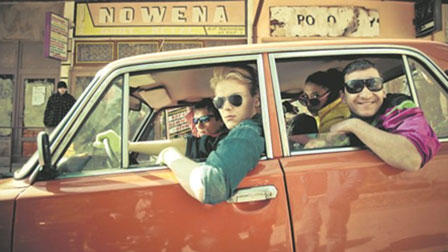
It's kind of a sexy film, I guess. Jakub Gierszal, who plays the protagonist Zyga, is a pretty faced actor who kind of drips a sort of sexual energy. Actually, almost everybody in the film does. The story starts toward the end of the 1980's, I imagine. Zyga and his best friend help this East German escapee get to the West German embassy. He gives them money that Zyga first tries to decline, but they end up accepting it, which leads them to a prostitute in the forest, which leads to hijinks, which leads to a traumatic experience which sets the film in motion, more or less. The friend disappears and comes back later on in the film as a deranged lawman. Basically it's about these kids who succumb to the madness for materialism that sweeps through the former Eastern Bloc after the Iron Curtain falls. We're informed at the beginning of the film that the area of Western Poland that borders Germany is called Juma (pronounced Yuma) and because stolen German goods are so widespread in that part of Poland, the word Juma has come to mean something about reselling stolen goods. So this is what Zyga gets mixed up with, naturally. Alongside all the massive trucks operated by the Russian mafia, Zyga starts smuggling stolen goods across the border, first Marlboro cigarettes at the behest of his brothel running aunt, and eventually anything you could think of. Things naturally go well for a while as Zyga and his friends run around town in their stylish threads blasting their stylish music and so forth and naturally things get out of hand. The protagonist is inspired by the old western 3:10 to Yuma. I haven't seen that film in a few years but I don't remember the plot being too similar to what happens here. Anyway, it's sort of an exciting movie, but sometimes the characters are weirdly mean given how likable they can be and how fluffy the film can be. In the end, it's an entertaining film, but not one you can always take seriously.
C

Dreams for Sale / Yume uru futar (Miwa Nishikawa, 2012, Japan)

A husband (Teruyuki Kagawa) and wife (the exquisite Takako Matsu) have this little restaurant that burns down during the dinner rush one night. The fire insurance doesn't go very far and they're desperate. The wife seems more okay with things, seeming relatively content to work a job at a cheap restaurant while they're working on getting a new restaurant. The husband's self pity basically turns him into a scoundrel. At one point he sleeps with some old acquaintance of theirs who gives him a bunch of money she doesn't want. The wife puts two and two together and comes up a plan that she dedicates herself to, seemingly to both make her husband's dream restaurant a reality and also to make him atone for what he's done with this other woman. This plan is to convince all these women that he's going to marry them and to weasel money out of them that they will eventually pay back with interest. As is often the case, the driving force in these schemes is pretty much the male ego, but as is also often the case, the woman ends up getting stuck with the blame. More or less. The film has an interesting premise and a lot of interesting characters. I just didn't really buy into a lot of the film's logic. Perhaps something was lost in translation, I have no idea.
C

Our Children / À perdre la raison (Joachim LaFosse, 2012, Belgium)


Belgium's submission to the Academy Awards foreign film competition, this film is apparently based on a true story. Perhaps if I had known that going in, it would informed my viewing in such a way that I didn't find the film such a downer. It kind of uses the Lars Von Trier template where you start out with this great woman, and this case a very likable new husband, and drag her through endless unpleasantness until something dramatic happens. The film starts with the woman ( Émilie Dequenne) in an emergency room telling the nurses that her children needed to be buried in Morocco. We then see some small coffins being transported and then we start at the beginning of their friendship. She's a school teacher dating this resident at a hospital or something, played by the guy from A Prophet (Tahar Rahim). The old guy plays his friend/mentor is the old guy from A Prophet (Niels Arestrup). For financial reasons the couple move in with the older friend, who turns out to be married to the guy's sister, and the wife starts banging out kids while the audience is left wondering what kind of strange relationship is going on with the two men. The husband gradually becomes less and less sympathetic, but the movie still seems to expect us to sympathize with him and his desperate family. I just read a review that called the film emotionally draining and that's exactly how I would describe it. Maybe it's because I'm not particularly interested in all this breeding stuff, but I didn't find anything particularly appealing about the film as a whole, though I like most of the actors well enough.
C

Guys and Balls / Männer wie wir (Sherry Hormann, 2004, Germany)

I hope this movie is as dated in Germany as it is here. I lived in Germany ten years ago and I thought it was strange that although the culture is relatively tolerant and progressive, that people were more comfortable with homosexuality in the abstract. I don't know, really, I never figured out what the deal was with gay culture there.

Here we have a gay sports comedy. Ecki, the goalie of his local soccer team, inadvertently comes out of the closet when he is seen making an unwanted pass at his best friend. He leaves his podunk town in shame and his parents become laughingstocks as he seeks refuge with his sister in Dortmund. He's challenged his team to play his gay team that doesn't exist yet in four weeks' time. He scours the underbelly of Dortmund until he finds enough leather daddies and kebab queens to man his team and naturally they go back to bumblefuck and continue to act out all of the sports movie tropes you'd expect. What makes the film problematic, other than it being a movie about soccer, is that it's an endless stream of gay stereotypes, homophobic humor, and cheap sentiment. It's so funny to me that Germans are thought of as these cold robotic types by a lot of people, but they're really as cornball as anyone else.

I liked certain members of the cast though and I automatically tend to like movies more just because they're in German since I like to listen to German, in case you're wondering about the charitable rating. I guess I also have a soft spot for gay movies, and even though this one is painful to watch sometimes, it seems to mean well.
C-

25 October 2012

Black's Game / Svartur á leik (Óskar Thór Axelsson, 2012, Iceland)

Pretty much everybody I met at the festival liked this movie. Ever the contrarian, perhaps, I wasn't quite as impressed. I thought it was a tacky, violent movie that glorified violence, nihilism, substance abuse, and cheap sexuality. The main character Stebbi is a miscreant who has just stumbled out of a jail where he's been booked for fucking some kid up when he was drunk. He runs into an old acquaintance from his hometown, Toti, all muscles and Satanic tattoos. Eventually, Stebbi does a dangerous job for Toti so this gangland lawyer will get him off of this heavy assault charge. Things go wrong during the job and Stebbi proves himself by going psycho on some important gangster or something. This earns him the nickname Psycho. Things go okay for a minute and then go out of control when this Satanic black metal looking criminal mastermind shows up and pushes it to the fucking limit. I didn't really buy all the plot elements, particularly a string of things toward the end of the film. It's also hard to care too much about these people because they're all evil, even though Stebbi is kind of attractive.
C

Postcards from the Zoo / Kebun binatang (Edwin, 2012, Indonesia)

A little girl loses her father in the zoo and apparently ends up staying and living there. That's the first few minutes of the movie. The rest of the movie takes place as she is an adult of indeterminate age, perhaps 20? I really wasn't sure. She wanders around the zoo, dreams of petting the giraffe's belly, and falls in love with a strange, silent cowboy magician. I liked this movie, in some ways, but mostly I was just kind of bored. That might be the pitfall of seeing five movies in one day at a film festival. I'm not sure. I can imagine myself liking this movie, but I didn't really engage with it at all when I saw it.
C

22 October 2012

After Lucia / Después de Lucía (Michel Franco, 2012, Mexico)

This film is Mexico's submission to the Academy Awards best foreign language film competition. It seems to be pretty popular with both audiences and critics, but somehow it didn't work for me as much as I expected it to.

In the film, Alejandra and her father have just relocated to Mexico City from Puerto Vallarta following the traumatic death of her mother. For reasons which can be speculated upon based on how the mother died, Alejandra never tells anyone at school that her mother is dead. At school, she falls in with a group of bratty, pot smoking miscreants who seem to be the popular kids. One weekend at a party she gets drunk and lets one of the boys film her having sex with him and the video gets sent all around school. For some reason, possibly relating to the jealousy of one of the other girls, Alejandra is then subject to bullying which is almost too harrowing to watch at times. The ending goes a somewhat different direction that you might expect, but it's not particularly satisfying. For me, the film's scenes of extreme cruelty seemed hard to believe, and this was exacerbated by failing sometimes to understand why these characters made some of the choices they made. It's definitely moving sometimes, maybe horrifying is a better word, but I'm not sure it earns the emotions it conjures.
C

21 October 2012

Boys Are Us (Peter Luisi, 2012, Switzerland)

For me, the main reason for watching this movie if you were interesting in seeing Zurich on film, or hearing the various ways that Swiss German, one of the more well preserved German dialects, is mingling with modern slang and so forth. But then, I'm guessing people with a minor in German linguistics are probably a small market.
It's a fairly entertaining teen soap opera that seems like it would belong more on television than in the cinema. It's kind of a banal story of a young woman scorned, her crazy sister, and the boys that fall prey to their vengeance. Of course, as a female, you know before the film even begins that the girl be a victim of her own vengeance, because of course. The film is supposedly elevated by its odd concept which I don't particularly understand the point of. It's a curious enough movie to warrant streaming online and the actors are engaging, but I don't know that I'd recommend paying $11 to see it, as I did.
C

19 October 2012

Something in the Air / Apres Mai (Olivier Assayas, 2012, France)

Here we have a well made bit of nostalgia. If you've ever spent much time in Europe you'll know that the spring of 1968 is as deep a well of nostalgia for Europeans as Woodstock is for Americans. The actors are nice, the filming is nice, the music is nice, but overall I didn't find the story or the characters terribly interesting. It felt too much like a bit of navel gazing nostalgia. Some priveleged artists play at bourgeois revolution.
C+

Bad Seeds / Comme un homme (Safy Nebbou, 2012, Belgium/France/Luxembourg)

Two boys kidnap one of their teachers for some stupid reason and this attractive, engaging film gets bogged down in this men who hate women vein. At a certain point even I get tired of seeing women as objects in male psychodrama. Newsflash: women are actually human beings. Oh well. Charles Berling from Summer Hours is effective as the father and in general the film is a gripping, attractively produced film that manages to be a much different film from what the basic premise would lead you to expect. I like film festival movies because they're good at taking a premise and delivering something different from what you'd expect. Unfortunately, part of that seems to be a trend in having the audience identify with characters who commit monstrous acts, which is probably unfortunate from a sociological perspective.
C+

The Bella Vista / El bella vista (Alicia Cano, Uruguay, 2012)

This relatively short feature documentary sounded quite promising. It's the story of an old soccer clubhouse which has become a transvestite brothel, according to some of the film's subjects. Nevermind that it seems to be more of a bar than anything else. It's about this sort of tranny bar in this small town in Uruguay. Everything seems to be going fine until a small group of geriatric men who used to play soccer together decide they want to run the faggots out of town. They eventually do this under false pretenses, more or less, and the building eventually becomes a Catholic church. The film is far too concerned with the mundane lives of the idiots who persecute the transsexuals as opposed to the transsexuals themselves, in my opinion and the film is also too sympathetic to them. I mean, it's an interesting film and I understand that we're dealing with a certain sense of the past being eroded by the modern world, but the dominant culture shouldn't have its apologies made for it as it forces people who are different into a dangerous demimonde. It's nice how this film considers change, and it does in a shot of one of the transsexual walking a menacing street indicate that they're essentially beneath the wheel, to borrow a metaphor from Hermann Hesse, but I guess as I was watching the film I was irritated by the smugness of the male characters. It doesn't seem like anybody learned anything in this movie, which I guess is what makes it authentic. Even as things change, they stay the same. As you can see, I have mixed emotions on this one.
C